Depression/Dementia in the elderly
One of the main themes of my film is depression in the elderly and the possibility of hallucinations which is often associated with early forms of dementia. My character Euiva is definitely suffering from depression and a fear of dying and at the end it is a possibility then entire world she has created is a hallucination spurred on by her fear of not 'leaving a legacy' when she dies. Because of these themes, I knew I had to become an expert in the subject so decided to research how common the conditions are and what other people similar to my character have experienced. I did this so that all the facts in my film would be relatable and verified.
Leaflet One- Royal College of Psychiatrists
http://www.rcpsych.ac.uk/healthadvice/problemsdisorders/depressioninolderadults.aspx
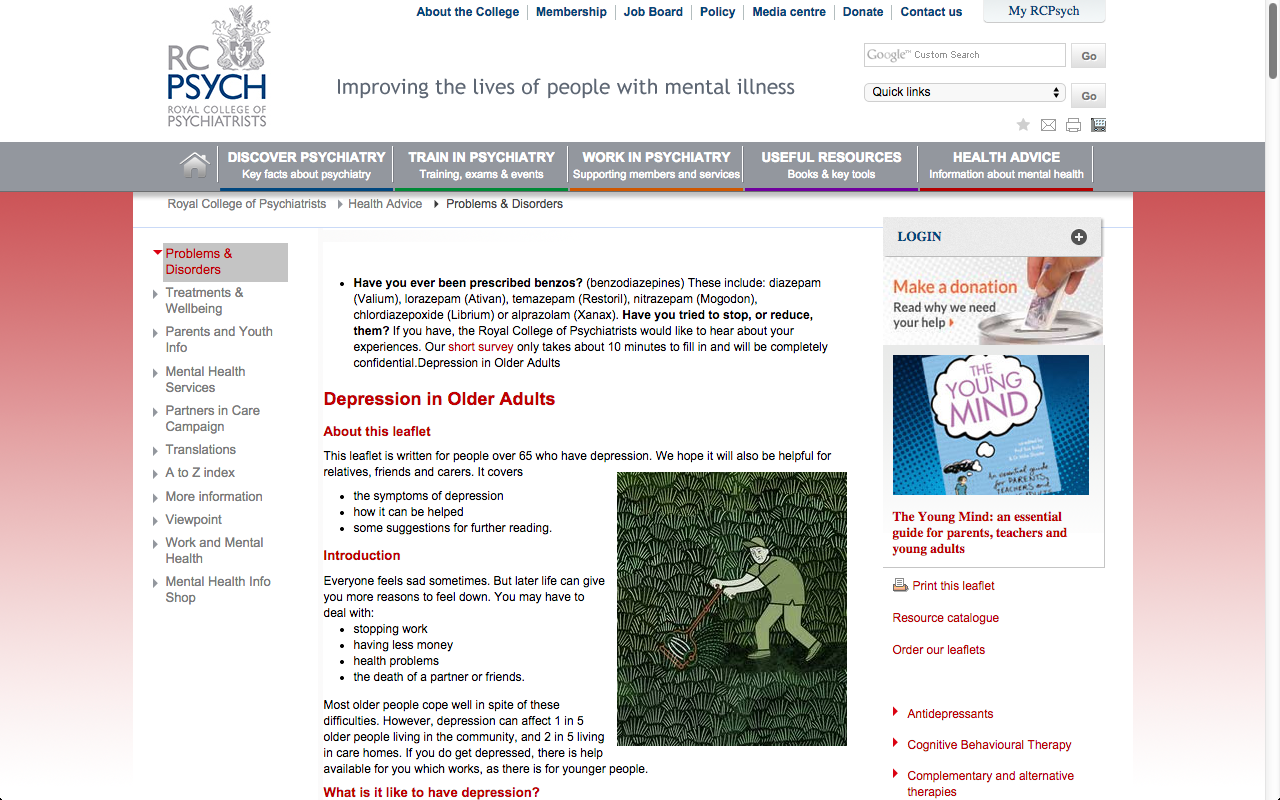
This leaflet gave me a lot of useful and basic information on what the difference was between normal depression and specifically depression in the elderly. A lot of the symptoms are the same, but the causes tend to be different. I was very shocked by the statistic that 1 out of 5 elderly people suffer from depression, and 2 out of 5 in care homes.
This leaflet helped me understand that being lonely and losing others around you when you are older is the most common cause of depression. This is really useful because in my film, Euiva is extremely lonely as you can tell by where she lives and the fact she is alone insinuates that she has lost someone. This means my character has a very good reason to suffer from the disorder I have said she is suffering from. I also learnt by the tone of the article that elderly people tend to not report their depression or go to the doctor about it as it is not physical. This is good for me to know because it shows that the disease is still regarded, especially by the older generation, as something not as serious as a physical disease which I can incorporate into my film as Euiva clearly is not being treated for it.
Finally, it was very helpful because it taught me about the other symptoms and even the treatment. Even though these will not be demonstrated visually in my film, I feel like it is really good to be aware of them so I am not at risk of misrepresenting the subject as it is very delicate.
Article 2- Universal Fear of Death and Cultural Response
http://www.sagepub.com/upm-data/5233_Bryant_Sample_Article_Universal_Fear.pdf
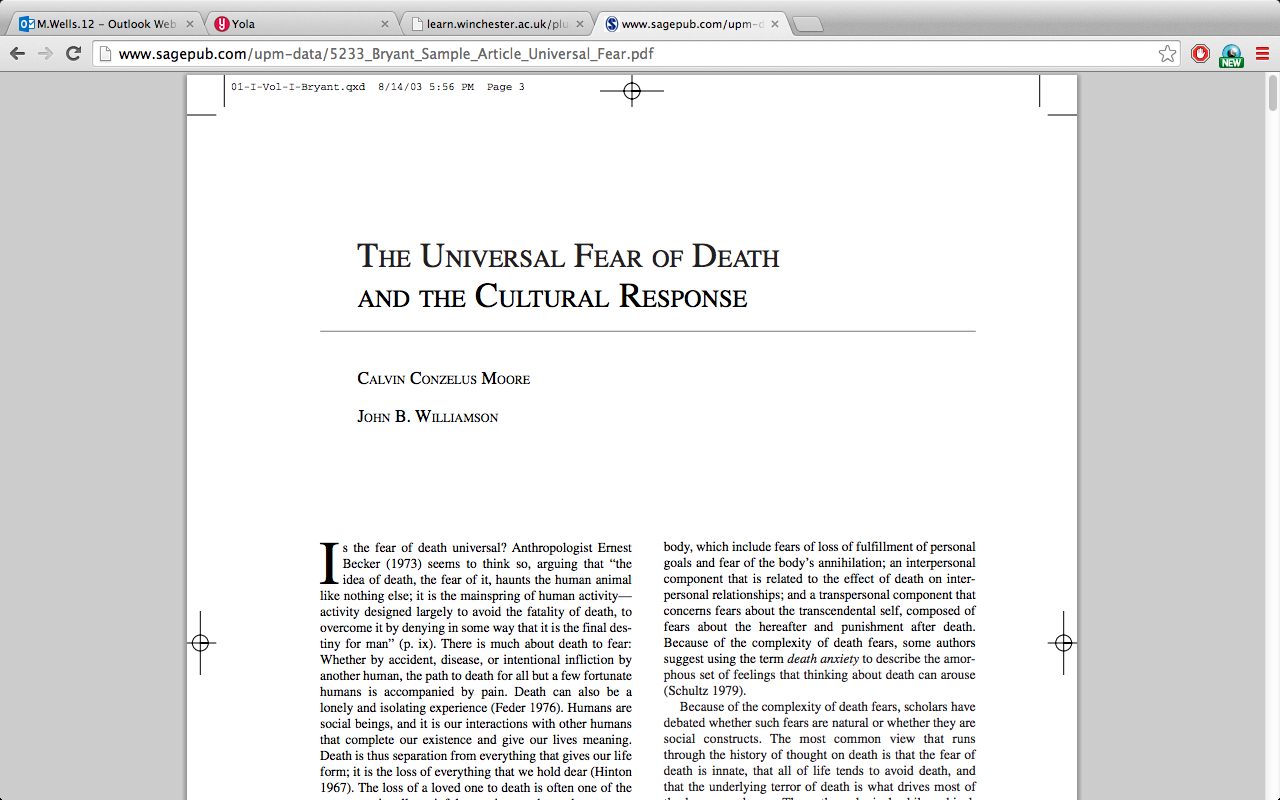
This article is extremely long and complex and explores all the attitudes towards death of every age group, but it had some very interesting insights into the fear of being 'forgotten', something which is relevant to my film. Euiva's character is so afraid of not leaving behind a legacy that it is possible she invented a multitude of characters in her head who she impacted in her life to make herself feel more accomplished. This ideal stems from a real fear, which I learnt is called Athazagoraphobia. This is a fear of being forgotten, and this article talks about that specifically when someone is about to die, e.g the fear of not leaving a 'legacy.' One quote which I found particularly useful was:
'Culture overcomes the fear of annihilation, the fear of being forgotten. Culture preserves an individual’s productions and thus allows the individual to achieve a form of “symbolic immortality'
I like this quote and think it relates well to my work because it suggests that if a person feels like they have made a difference to culture and to the lives of other people, they feel as though they will never be forgotten, thus achieving a form of immortality. Of course the technicalities of it are much more complex, but this overall suggestion supports Euiva's actions in my film, when she embeds herself in the lives of other people to feel like she is going to be remembered after she dies.
Article 3- Dementia and Hallucinations
http://www.dementiatoday.com/hallucinations-in-people-with-dementia/
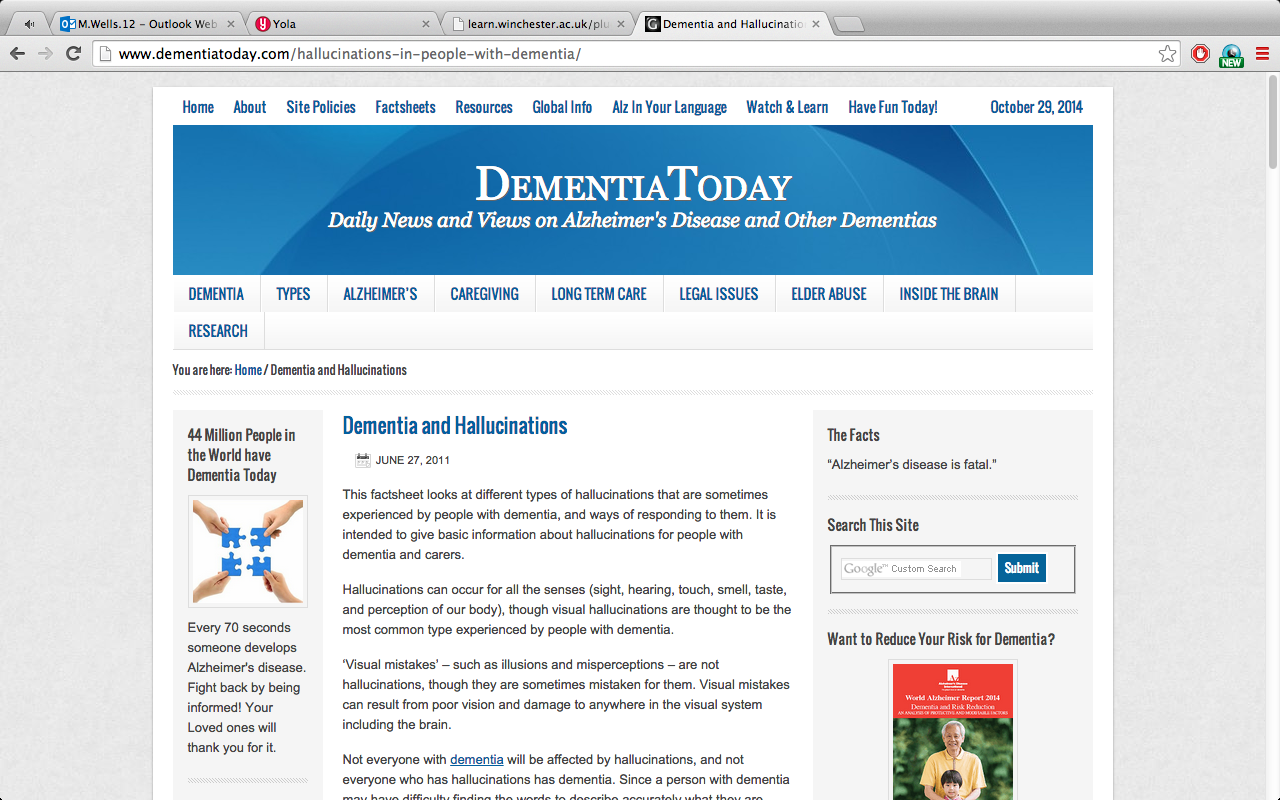
This article formed part of the final bit of literary research I had to undertake to become an expert in the topics of my film. My knowledge of dementia was already fairly strong, but I needed to know more about the specific link between dementia and hallucinations so I could justify the possibility that Euiva is hallucinating the colours she sees in real life.
This article was really useful because it helped me understand the different types of hallucinations people with dementia have, from visual to multi-sensory which incorporates the whole body. It helped me define that Euiva is only having 'visual' hallucinations, which are the most common amongst patients. It also talked about the fact that when healthy people have hallucinations (which are surprisingly common) they can usually use 'reality checks' so that the hallucinations do not blur into real life.
People with dementia will often lose this ability, and sometimes it seems they may have a desire for the hallucinations if they cause happiness or good feelings. This bodes well for Euiva's character, because she is having hallucinations which actually cause her happiness, so she has no desire to shut them off. Knowing that this link between hallucinations and dementia is common is very useful for me because it means that it is believable that Euiva could be suffering from this, and it is a fair assumption the audience might make at the end of the film; therefore keeping the 'open' ending
