
This article was based on the idea that if you paint a room a certain colour, it will induce a better mood and outlook on life. I loved the quote at the beginning which read '
Colour is a universal, nonverbal language and we all intuitavely know how to speak it.'
This idea is exactly what I want to communicate in my film, the concept of colour as a living, breathing entity which humans are naturally harmonious with. The website analysed the connotations of every colour, stating that red was a way of 'inviting people to sit down' and even increase the heart rate, a physiological side affect as well as a psychological one. It also stated that blue was a calming colour, and that you should use colours from your childhood to recreate the same atmosphere in your modern life.
I think this article, although principally about the decoration of a home, was very useful in my research for my project because it shows how the themes in my project relate to everyday life.
Article 2- National Academy of Sciences in the USA
http://www.ncbi.nlm.nih.gov/pmc/articles/PMC2889342/
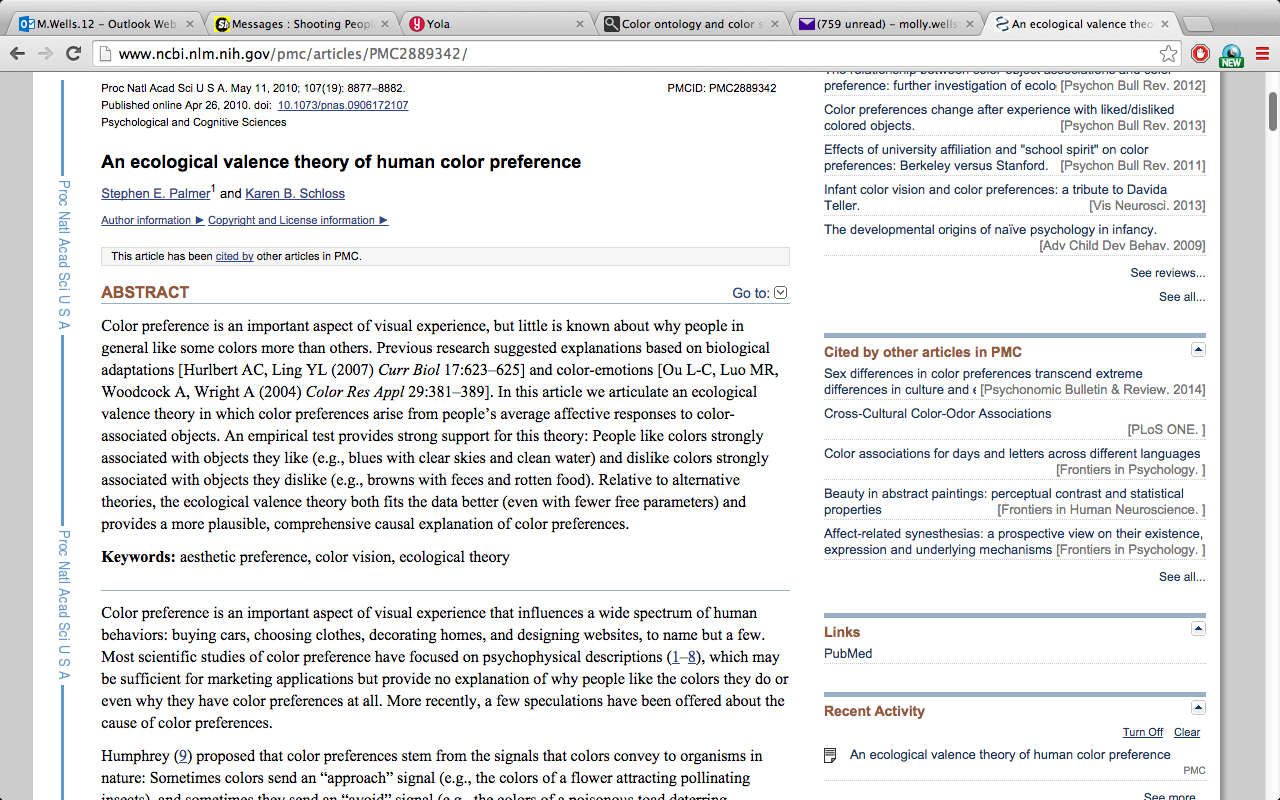
This article is an in depth analysis of why human beings are drawn towards certain colour. The entire piece is extremely scientific and examines the relationship between personality and colour from every angle, from emotional relevance to genetics, but some of the overall points were fascinating and it was the perfect article for me to read in relation to my film. The article was also a very useful tool in helping me realise the subjectivity of colour representation. Despite thorough experiments and analysis; there was still no definitive answer on what makes a certain person like a particular colour more than others. This subjectivity gives me a lot of room and versatility to exploit the colour personalities in my film which is very useful. It also means that if I have enough knowledge about the significance of colour in society, I can use the concept to twist and shape the meaning to suit the overall message of the film. The part of this article I enjoyed the most was the explanation on 'colour emotion' which gave me an insight into the categories colours are generally placed in. It states: '67% of the variance in their color preference data could be predicted from three factor-analytic dimensions derived from color-emotion data: active/passive (active preferred), heavy/light (light preferred), and warm/cool (cool preferred).' This is helpful because I can apply these same colour categorisations to the personality of my characters to make it topical and relevant. A character can easily be more active than passive, and even 'warm/cool' and 'heavy/light' can be incorporated.
Article 3- Colour and Storytelling in Films
http://www.robertmills.me/colour-and-storytelling-in-films/
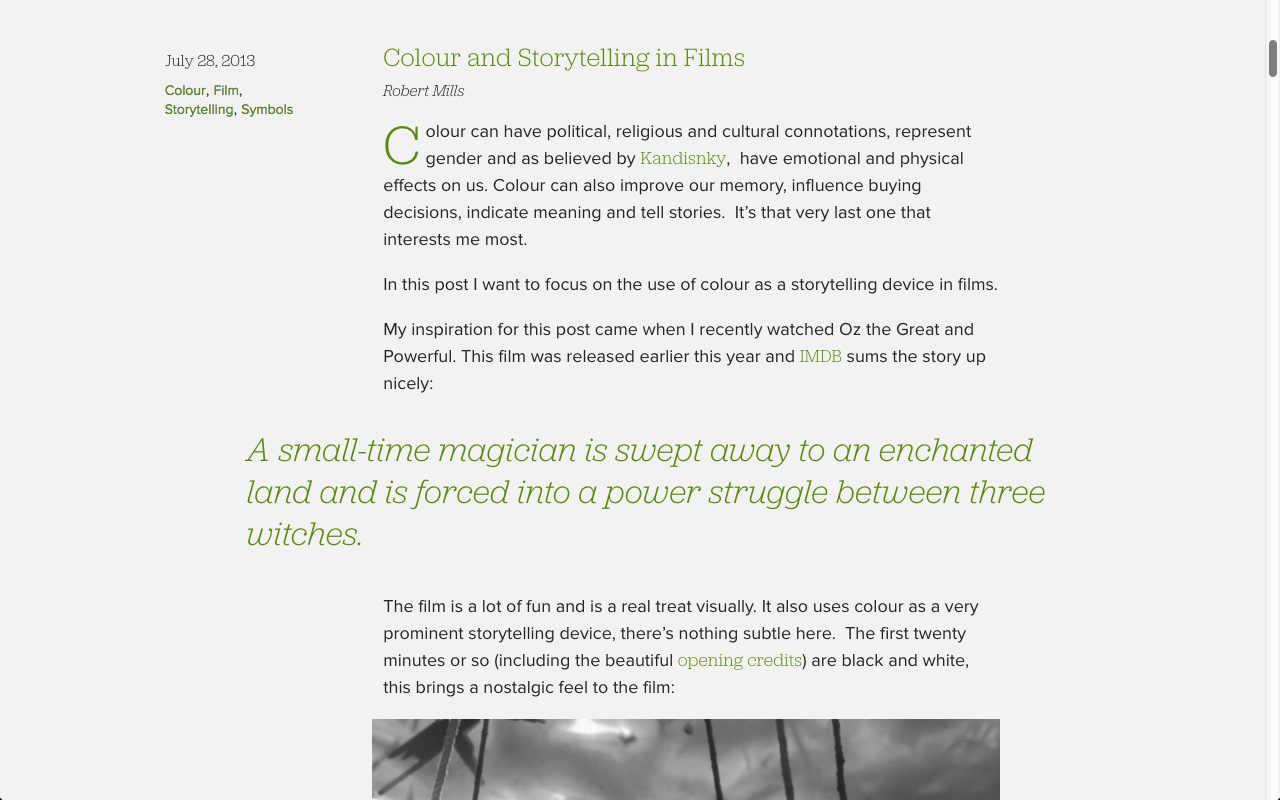
This article focused more on the connotation of colour in films visually- both as a way of communicating emotion and creating associations for a certain character. This article was very useful for me in terms of what I am technically trying to acheive cinematically. Robert Mills analyses the use of colour in particular films, from the iconic black and white/colour distinction in the Wizard of Oz to the filters used in Steven Soderbergh’s 'Traffic' and 'Pan's Labyrinth.' I found his distinctions and findings fascinating, especially when he analysed that the reason 'Belle' from 'Beauty and the Beast' was dressed in blue was to signify her difference to everyone else in the film; a finding that seems obvious once you see the picture. These subtle connotations are also present in Hitchcock's 'Psycho' where Marian's clothing colour changes from white to black because:
'white has connotations of purity, being angelic and innocence whereas black is a colour associated with darker character traits, naughtiness, guilt and evil'
These seem very basic but have a big impact on the subliminal messaging of the film. I also was made aware of this article of the film 'Pleasantville' which has similar components to my own film in the visual use of colour. Now when I edit the film, I will avoid techniques that are used too often in other colour themed films.
Overall this was an incredibly influential article and it really helped me understand how I can use the concept of colour visually in the storytelling as well as in the dialogue and underlying message of the plot.
