Avant- Garde (Experimental) Filmmaking
Once I decided that I wanted to produce my film using primarily the same 'interview room' setting I knew I would have to use lots of different filmic techniques to fully exploit the film cinematically. As my piece became more and more poetic and slightly abstract with each draft, it became natural that I would begin to draw on the 'avant-garde' techniques used in experimental filmmaking which also share the same symbolism so I decided to research this style to gain inspiration from it.
Literature One- 'Avant-Garde Film (1926-1995)' An Anthology of Writings edited by MICHAEL O' PRAY.
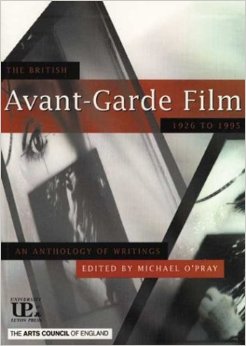
I decided to take a look at this book to get a general idea about the style of avant-garde and its origins. I looked particularly at the Introduction and also a chapter called 'Incursions and Inclusions' by ROD STONEMAN which looked at the transition of avant-garde from film to television.
I learnt from this book that actually the avant-garde term is extremely broad. In the Introduction to the book it states that avant- garde 'does not have a stable mode of production, distribution or exhibition' and has 'despised popularity' and 'revelled in the obscure.' I took from this that the avant-garde is a term used for a piece which does not follow a traditional filming style and narrative.
This applies to 'The Prism' because there is no linear narrative to begin with, and I plan to film it all in one location, which is fairly unusual. It also taught me that in the past, the main avant-garde movements have been in the 1920's and 1960's/70's. At both of these times the book states that 'these were periods of intense activity and experimentation in sculpture, painting, photography, performance, theatre and film.' This history is very useful for me because it told me that avant-garde easily overlaps into other creative mediums. Because my film is extremely theatrical at its core, because of the use of 'black box' stage shots and the amount of dialogue, it is already following the conventions of avant-garde.
Literature Two- 'Avant-Garde Film Motion Studies' By SCOTT MACDONALD
This book was an extended reading about avant-garde film and was useful in defining, in slightly simpler terms than the last book, what defines the avant-garde mode in more modern times. The Introduction was very useful, and I liked the way the writer related the mode to the audience.
One of the quotes I found useful in research was, 'by the time most people have seen their first avant-garde film, they have already seen hundreds of films in commercial theatres and on television, and their sense of what a movie is has almost indelibly been imprinted in their conscious.' I liked this because it suggested that the avant-garde is only considered such an experimental and obscure style of filming because commercial filming has already brainwashed the public into thinking that it is the norm. It suggests that avant-garde is niche only because it does not follow popular culture, which is an idea I will keep in mind when filming and editing my piece; that I don't have to follow the rules laid down by the majority of other short films.
It also quoted that avant-garde 'foregrounded abstract imagery and rhymes' which relates to my piece because I am visually going to show the 'colour' that the characters possess which is going to have to be done in an abstract manner to be successful.
Films
Meshes of the Afternoon: Directed by Maya Derren and Alexander Hammin
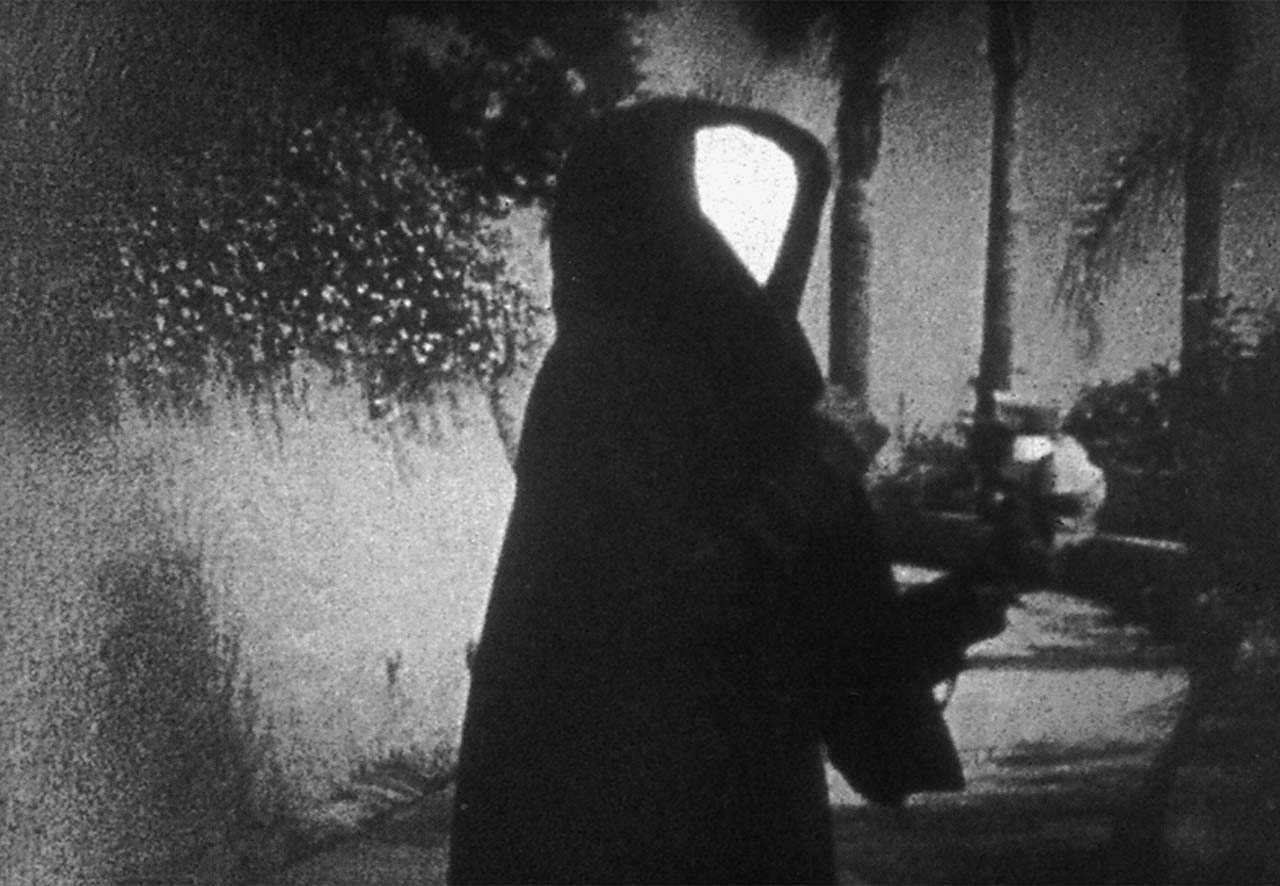
'Meshes of the Afternoon' is a short experimental film made in 1943. It is one of the defining experimental films and was selected to be preserved in 1990 by the US government.
This is the first avant-garde film I decided to examine and it was definitely one of the most inspiring. I loved the unconventional camera angles and long takes which do not usually appear in modern short films. I also was inspired by the films use of mirror and shadows to create a certain mood or theme. The 'grim reaper' creature was extremely simplistic, but through the use of lighting and costume he appeared to be extremely creepy and significant.
I have definitely taken some aspects from this film which I would like to incorporate into my own. Because of my simplistic setting I would like to try and utilise camera 'tricks' to help me get the most versatility and use mirrors and shadows to create interesting and dynamic shots. I also want to use image in the same way 'Meshes of the Afternoon' does to convey certain feelings and moods.
Rabbit's Moon: Directed by Kenneth Anger
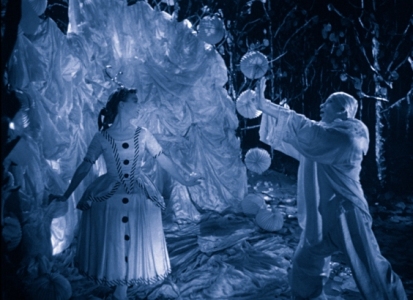
Rabbit's Moon is a short avant-garde film released in 1972 from America Writer Kenneth Anger. The film was made in 1950 and revolves around the character of a clown and his desperate attempts to capture the moon.
This film was very different from the previous, and I was particularly inspired by the use of colour and abstract imagery. A blue tint was put on the entire film which is very effective because it makes the scene look more dramatic and immediately less conventional. It also blends in with the colour of the moon, which is the central image of the film. As I am planning to use colour tints in post production, this film was a good insight into the effect it creates and how it fits in with the avant-garde genre.
The film was extremely theatrical; another example of the blending of different creative mediums expressed in avant-garde. This is a very useful technique in focusing on characterisation rather than other filmic techniques. It also shows how simplicity can be just as effective in avant-garde as complex filming. This was very useful for me to learn because I am going to have to exploit simplistic filming and make it complex and deep just like 'Rabbit Moon' has achieved.
Gently Down The Stream: Directed by Su Friedrich
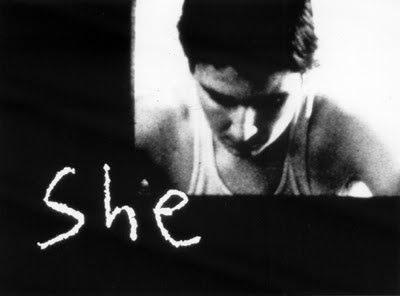
'Gently Down The Stream' is an avant-garde film made in 1981. I chose this one because it is an example of more modern avant-garde made after the 1960's. The film combines text and images to explain dreams she had and wrote down in a journal.
This film, for me, is about as abstract as a short film can get. Despite being considered slightly more 'modern' than the others I have looked at, it is still a silent film in black and white which are typically considered 'classic' filmic devices. I think the fact that avant-garde continues to use these techniques in modern films shows a rebellion against modern film.
I find the 'dream' themes of this film and the way they are communicated very interesting. I had not considered the use of text in my own film before, but seeing it being utilised very successfully in this short proves that I can use it if I want to make a certain point or convey a mystery. I liked the use of still image as well with post production flickers and movement. It is almost like a slideshow rather than a short film but because it holds the tag 'avant-garde' it seems to be able to get away from it. I admire the aesthetics and the meaning behind the simplistic way of filming. I have definitely been inspired by this film to test the boundaries of film-making and use other creative mediums to experiment with them.
History
Luis Bunuel

Luis Bunuel was part of the avant-garde movement in the 1920s whose first film was 'Un Chien Andalou'(1929), one of the most famous experimental films of all time. He was born in 1900 and met surreal artist Salvador Dali in college, whom he collaborated with on occasions. His films were extremely controversial because of their 'anti-catholic' imagery (e.g a man drags pianos with priests on them in 'Un Chien Andalou') and Bunuel continued to use his anti-clericalism in his future films 'L'Age d'Or' (1930) and documentary 'Land without Bread' (1932) Later in life, he worked in the foreign departments of Warner Bros and Paramount Pictures and produced many more films in the US, Spain and Mexico. Despite his controversy, he is still considered to be a one of the most creative experimental filmmakers.
Lettrism
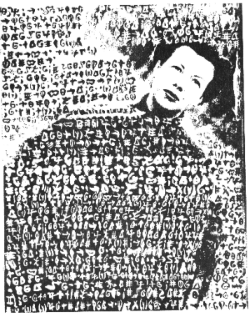
'Lettrism' was an avant-garde movement in France established in the 1940s pioneered by Isidore Isou. It is the creation of art centred around letters; in art, music and film. However, in the lettrist work, the letters are not supposed to form any meaning, they are merely a means of expression and become part of the art themself. In relation to film, Isou believed in tearing the way classical film imagery and making it unrecognizable, finding scraps of film in bins and vandalising the reel with graffiti to turn it into something different. He was often referred to as 'chiselling' film. He also believed that there was no link between sound and image and that they were completely different paths, which is clear in his non-cinematic film, Le Traité de bave et d’éternté
